The Crafty Talk #1 – Cotton Yarn

Hey, hello, and hi! Welcome to the very first post of The Crafty Talk.
I’ll be real with you: I have a serious problem with starting series. I think it’s my inner perfectionist trying to convince me that if I just categorize everything into neat little boxes, my life will suddenly be organized. (Spoiler: It won’t, but it does make it way easier for me to actually post things!) I’m even debating starting a YouTube or a podcast for this, but let’s not get ahead of ourselves here.
Anyway, today we’re talking about the fiber that everyone has an opinion on: Cotton. So, grab your drink of choice—I’ve got my tea—and let’s get into it.
I find cotton very… Honest
Some people treat it like the holy grail of summer crafting, while others avoid it like a centre pull. I’m personally a huge fan of cotton. With cotton you always know what you get. Uneven tension? It shows. Sloppy stitches, yup, you can see those too. But it’s cheap, it’s everywhere, and it’s versatile.
But then there’s the “S” word: Sustainability. You might be thinking, “It’s a plant. It grows in the dirt. How could it NOT be sustainable?” I hate to be the bearer of bad news, but modern cotton farming can be pretty resource-heavy. It uses a lot of water, and often a fair amount of pesticides too. So while it’s natural, it’s not always as green as it sounds.
If you want to feel a bit better about your stash, look for organic or recycled cotton. Or, do what I do and hunt for second-hand yarn. There’s something deeply satisfying about rescuing a skein of cotton from a thrift store shelf.

Why do I think that cotton yarn is great?
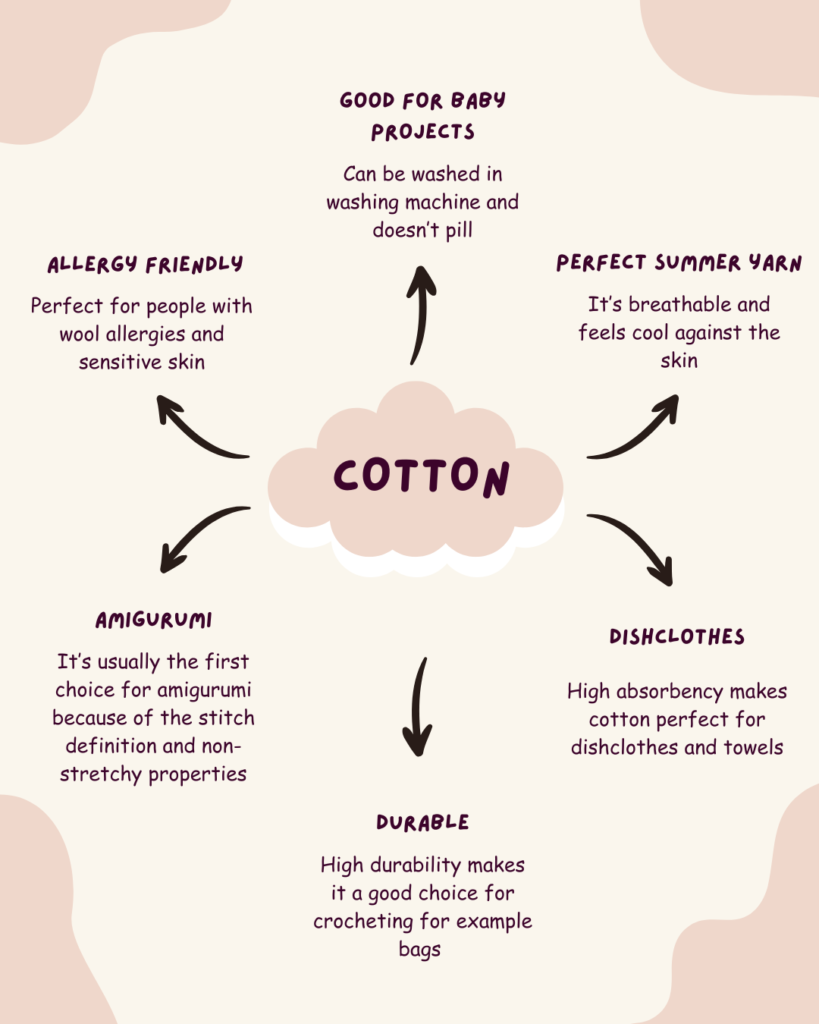
Even if it’s a thirsty plant, cotton has some major perks. For starters, it actually lets your skin breathe. This makes it a great choice for:
- Summer garments
- Baby items
- Anyone who finds wool about as comfortable as wearing a cactus AKA has sensitive skin.
A quick warning though: Do not try to make a cozy winter sweater out of 100% cotton. You will end up with a heavy, cold garment that feels like wearing a damp towel. Cotton doesn’t trap heat; it lets it escape. It’s a summer romance, not a winter soulmate.
Where cotton truly wins is in the “practical stuff.” Think dishcloths, market bags, and amigurumi.
Why? Because cotton has structure. It doesn’t get all fuzzy and blurred over time. And can we talk about the stitch definition? My goodness. Every single stitch looks crisp and clean. If you’ve been practicing a fancy new textured pattern, cotton is going to make you look like a pro because it shows off every twist and turn of your hook.
A short “Cheat Sheet”
If you’ve ever been confused by the labels, here’s the breakdown:
- Mercerized: This is the “fancy” one. It’s been treated to be shiny and hold onto dye like its life depends on it. Great for clothes.
- Unmercerized: This looks more “boho” and natural. It’s matte, soft, and super absorbent—perfect for that dishcloth you’re definitely going to finish… one day.
- Pima & Egyptian: This is the luxury stuff. Long fibers mean it’s smoother and won’t fray as easily. Treat yourself. I don’t think I’ve ever used this kind of cotton.
- Recycled: Great for the planet, usually has a cool, rustic texture. Be aware that the ones I’ve tried split easily.
Wait… But why are there fractions on my yarn label? (8/4 vs 8/8).
Don’t worry, you don’t need a calculator. Here is it means:
- The first number (8) is the thickness of the individual tiny threads (the plies).
- The second number (4 or 8) is how many of those threads are twisted together.
So, 8/4 is 4 threads twisted together. It’s usually a “Fingering” or “Sport” weight—thin, dainty, and perfect for light summer tops or detailed amigurumi.
8/8 is 8 threads twisted together. It’s exactly double the thickness of 8/4, usually landing in the “DK” or “Light Worsted” category. It’s the one I grab for sturdy market bags or dishcloths because it works up faster and feels more substantial.
Pro-tip: If a pattern calls for 8/8 but you only have 8/4, you can just hold two strands of the 8/4 together.Tadaaa!
One last thing to remember
Cotton is not stretchy. Like, not at all. But! This lack of stretch is exactly why I’m using it for the bag I’m working on right now. And why all my other bags and totes are made of cotton. Because when I inevitably fill that bag with my phone, my wallet, and 3 random stones my toddler handed me—the bag isn’t going to stretch down to my ankles.
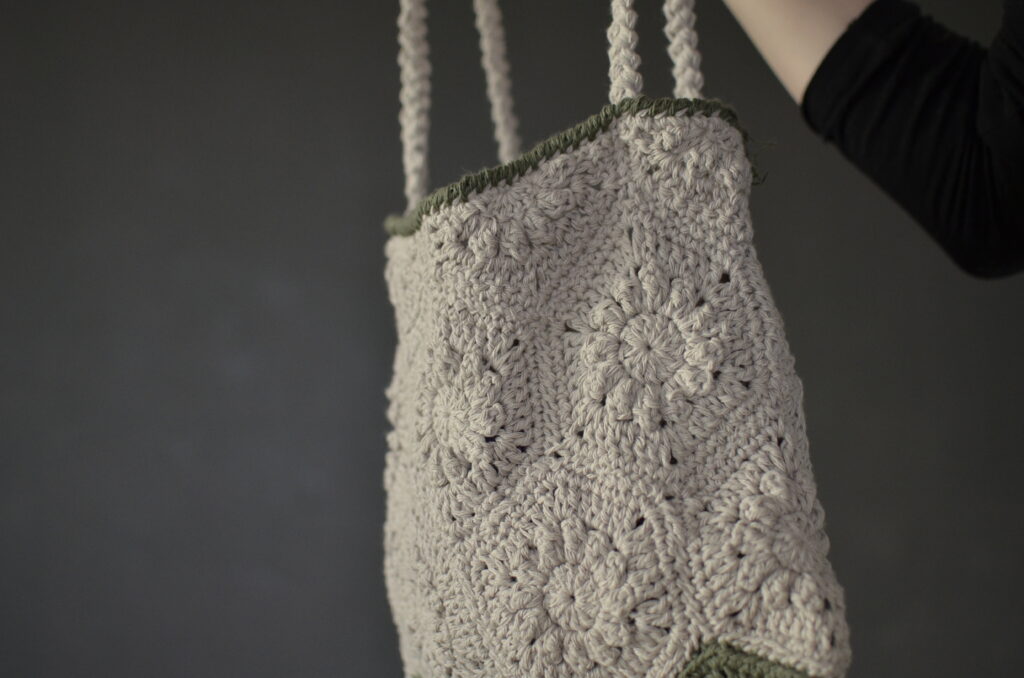
That’s it! Are you a cotton lover or hater? What’s the last project you’ve used cotton yarn for?
See you soon, Wiktoria @Croove.Studio
